
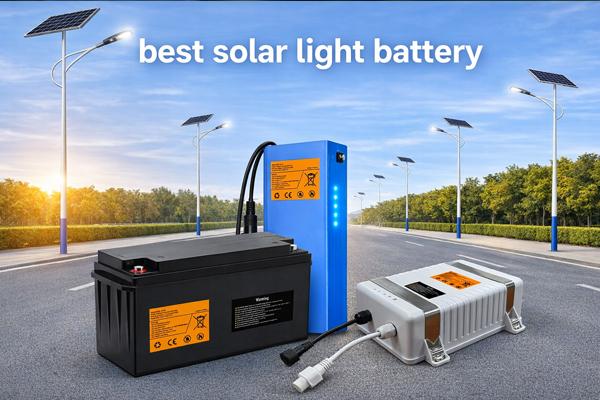
The Complete Guide to Solar Light Batteries: Types, Lifespan, and Replacement Tips
Thinking of using solar lights in your garden or around the house? It’s important to understand the role of batteries in how they work. This guide will walk you through everything you need to know about batteries in solar lights, including the types, lifespan, and how to replace them.
Do Solar Lights Need Batteries?
Many people ask do solar lights need batteries, and in real-world use the answer is yes—almost all of them do. Most solar lights have a built-in rechargeable battery and actually require it to work as expected after dark. The solar panel’s role is to collect sunlight during the day and charge the battery; at night, the light runs entirely on the stored energy. Without a battery, a solar light would only turn on in direct sunlight, which makes it impractical for nighttime use.
This applies across nearly all common solar lighting types, including LED landscape and garden lights, decorative fairy and string lights, deck and pathway lights, outdoor Christmas lights, and larger systems like solar street lights, flood lights, and security motion lights.
Even solar lights designed for seasonal use or decoration still rely on a battery to provide consistent brightness and automatic operation at night. While a few niche designs exist that operate without batteries, they are rare and limited to daytime-only applications. In everyday outdoor lighting, batteries are what make solar lights reliable, predictable, and usable long after the sun goes down.
What Type of Batteries for Solar Lights?
We want the best battery, it’s important to start with a clear rule: solar light batteries are always rechargeable. Solar lights charge and discharge every single day, so non-rechargeable batteries are not suitable and should never be used. Even though AA and AAA batteries are available in both disposable and rechargeable versions, solar lights require rechargeable batteries by design. This daily cycling is exactly what makes solar light batteries different from ordinary household cells.
So, are solar light batteries different? In practice, yes. While they may look like standard AA or AAA batteries on the outside, solar light batteries are chosen specifically for cycle life, tolerance to overcharging, and outdoor temperature stability. The most common rechargeable battery chemistries used in solar lights are NiMH (nickel-metal hydride), NiCd (nickel-cadmium), lead-acid, and increasingly lithium-based batteries.

NiMH (Nickel-Metal Hydride): The Most Common Choice
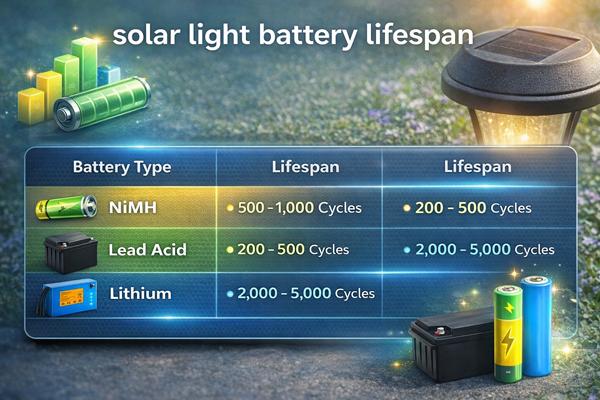
Rechargeable NiMH batteries are the most widely used option in small to medium solar lights, especially LED landscape, garden, pathway, deck, fairy, and string lights that use AA or AAA cells. NiMH batteries offer good energy density, reasonable cost, and strong resistance to memory effect. According to Battery University, NiMH batteries typically deliver 500–1,000 full charge cycles, making them well suited for daily solar charging. This balance of lifespan, safety, and availability is why NiMH has become the default choice for consumer solar lighting.
NiCd (Nickel-Cadmium): Durable but Declining
NiCd batteries were once extremely common in older solar lighting because they tolerate overcharging and extreme temperatures very well. They can reach 1,000+ charge cycles, which made them popular for outdoor use. However, NiCd contains cadmium, a toxic heavy metal, and is increasingly restricted by environmental regulations in many regions. As a result, NiCd is gradually being replaced by NiMH in most modern solar lighting products.
Lithium Batteries: Growing Fast in Modern Solar Lights
Lithium rechargeable batteries (including lithium-ion and lithium iron phosphate) are now widely used in higher-end solar lights, security lights, motion-activated lights, flood lights, and solar street lights. Lithium batteries offer much higher energy density, lighter weight, and longer lifespan. Battery University reports that lithium-ion batteries can typically achieve 1,000–2,000 charge cycles, depending on depth of discharge and temperature conditions. This makes lithium an excellent choice where higher brightness, longer runtime, or compact battery design is required.
Lead-Acid Batteries: Large Solar Installations
Lead-acid batteries are still used in larger solarlighting systems such as solar street lights and off-grid outdoor installations. While heavy and less energy-dense, lead-acid batteries are inexpensive, robust, and well understood. They are designed for deep cycling and remain common where space and weight are less critical.
All solar lights have and require rechargeable batteries. Whether the battery is NiMH, NiCd, lithium, or lead-acid depends on the light’s size, brightness, and application—but non-rechargeable batteries are never the correct choice. The daily charging cycle is what makes solar light batteries different, and choosing the right rechargeable chemistry directly affects brightness, lifespan, and reliability.
What Are the Best Rechargeable Batteries for Solar Lights?
When choosing the best rechargeable batteries for solar lights, the key factor today is battery chemistry, not just size. Traditional solar lights commonly used NiMH or NiCd AA and AAA batteries, but the market has shifted significantly. Modern AA and AAA lithium batteries are now widely available, and they offer much higher energy density, longer runtime, lower self-discharge, and better performance in hot and cold outdoor conditions compared with NiMH or NiCd. This makes lithium AA and AAA batteries a clear upgrade for many garden, pathway, and decorative solar lights.
For larger or higher-power solar lights—such as security lights, flood lights, and some street-style fixtures—cylindrical lithium cells like 18650 and 18500 are commonly used. These cells can store far more energy than AA or AAA formats and are designed for repeated charge cycles.
Among them, well-known brands such as Samsung, LG, and Panasonic are often regarded as top-tier due to their consistent quality, safety standards, and long cycle life. At the same time, EVE Energy, a leading Chinese lithium battery manufacturer, has built a strong global reputation for producing high-quality cells that meet demanding performance and reliability requirements in solar lighting and energy storage applications.

Where to Buy Rechargeable Batteries for Solar Lights
Rechargeable batteries used in solar lights cover a wide range of options. A solar light battery can come in different sizes and formats—such as AA, AAA, 18650, or custom packs—and today the most commonly used and best-performing choice in the market is lithium. Compared with older NiMH or NiCd batteries, lithium batteries for solar lights offer higher energy density, longer runtime, lower self-discharge, and better performance in outdoor environments.
That said, lithium batteries for solar lights are not all the same. They differ in chemistry, capacity, discharge rate, cycle life, temperature tolerance, and protection design. These technical parameters are critical for solar lighting performance, but they can be confusing for end users and even for some product integrators. Choosing the wrong battery may lead to short runtime, early failure, or compatibility issues with the solar controller.
For this reason, buying from a professional lithium battery supplier—ideally a direct manufacturer—is usually the most reliable option. An experienced factory can recommend the right battery type based on your specific solar light application, whether it’s garden lighting, pathway lights, security lights, or larger solar installations. As a professional lithium battery manufacturer, Whale Battery supplies lithium battery solutions for solar lighting systems and can provide solar light battery packs in a range of sizes, capacities, and configurations to match different outdoor applications.
How to Replace Solar Light Batteries
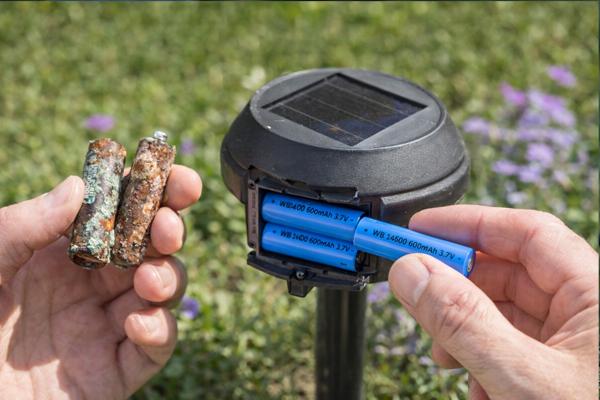
Replacing solar light batteries is not a one-size-fits-all task. The correct replacement depends first on the original battery type used in the light. Common solar light batteries include lithium, NiMH, NiCd, and lead-acid. Before changing anything, you should identify the existing battery’s chemistry, voltage, and size—because these determine what can be safely installed as a substitute.
Another key factor is physical space inside the solarlight housing. Different products use different battery sizes, so what size battery for solarlights depends entirely on the specific fixture. Small garden or pathway lights often use AA or AAA cells, while larger security or street-style lights may use cylindrical lithium cells or sealed battery packs. If the enclosure has enough room, it is sometimes possible to replace the original battery with a higher-capacity version of the same voltage to improve runtime. However, this must be done carefully to avoid overheating or charging issues.
In some cases, different battery types can be replaced with one another, but this requires technical knowledge. For example, NiMH or NiCd batteries are sometimes upgraded to lithium batteries because lithium offers higher energy density and longer lifespan.
This lithium battery upgrade has become the most popular approach in recent years, but it must account for charging voltage, protection circuitry, and compatibility with the solar controller. Without proper design, an incorrect replacement can shorten battery life or damage the solar light.
Overall, how to change solar light batteries comes down to three things: matching the correct voltage, choosing the right battery size, and ensuring the chemistry is compatible with the charging system. Simple swaps using the same battery type are usually straightforward, while upgrades—especially to lithium—should be handled with more care or professional guidance to ensure safety and long-term performance.
How Long Do Solar Street Light Batteries Last
When planning or maintaining solar street lights, one of the biggest questions is how long the batteries will last, because the battery is typically the component that needs replacing most often on a long-life system. Solar street light batteries are usually either lead-acid or lithium-based depending on the size and type of installation.
Lead-acid batteries are a traditional choice and can be effective for budget installations, but they tend to have a shorter useful lifespan—typically around 3 to 5 years under regular daily cycling. In contrast, modern lithium-based options, especially lithium iron phosphate (LiFePO₄) chemistry, are widely used because they deliver higher cycle life, better depth-of-discharge performance and longer overall service life; many high-quality lithium street light batteries reliably last 5 to 10 years or more in everyday use.
The shorter lifespan of lead-acid batteries is tied to their lower cycle life and sensitivity to deep discharge; they may reach end-of-life after a few hundred cycles and require multiple replacements over the life of the lighting system.
Lithium batteries, on the other hand, often support thousands of charge/discharge cycles and maintain capacity better over time, which not only extends runtime but also reduces total lifecycle maintenance and replacement costs.
When looking for a long lasting replacement solution for solar street light batteries, many project-level designers and suppliers prioritize lithium options because of this durability advantage.
In practical terms, choosing the right battery type makes a big difference in both performance and total cost of ownership. While lead-acid may be cheaper up front, lithium batteries tend to deliver superior lifespan and endurance, especially for medium and large-scale solar street light installations where reliability and low maintenance are critical.
Regular maintenance, environmental exposure and discharge depth will also influence actual service life, but in comparable conditions lithium battery systems generally outlast lead-acid ones by a significant margin.
Conclusion
Solar street light battery life depends mainly on battery chemistry, depth of discharge, and daily cycling conditions, but the trend is clear: lead-acid systems usually require earlier replacement because their cycle life and usable capacity drop faster under repeated deep discharge, while lithium—especially LiFePO₄—delivers longer runtime, more stable performance, and far more charge cycles over its service life.
For most medium and large solar street light projects, this means lithium batteries typically provide a lower total cost of ownership and fewer maintenance interventions, making a long lasting lithium battery a practical replacement choice when upgrading older lead-acid installations.